Technology is evolving faster than ever. From artificial intelligence and smart devices to quantum computing and advanced cybersecurity, digital innovation is changing how we live, work, communicate, and do business.
The future will be increasingly connected, automated, and intelligent. Businesses that understand emerging technology trends will be better prepared to compete in the digital economy.https://en.wikipedia.org/wiki/Technology
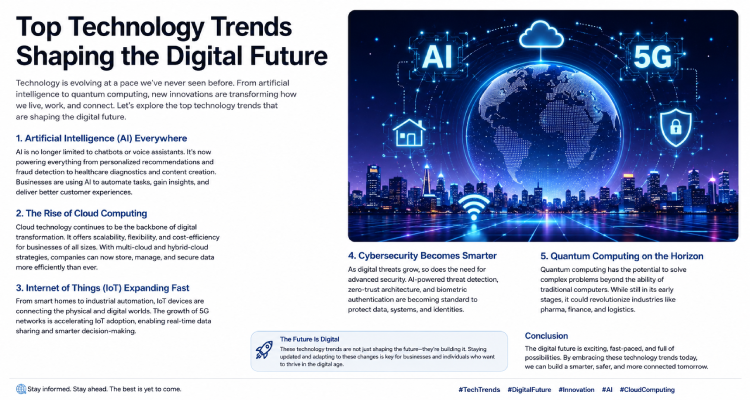
Here are some of the top technology trends shaping the digital future.
1. Artificial Intelligence (AI) Will Become More Powerful
Artificial Intelligence is no longer just a futuristic concept. AI is already being used in search engines, customer service, healthcare, marketing, education, finance, and many other industries.
Generative AI tools can create content, analyze information, automate repetitive tasks, and help businesses make faster decisions.
In the coming years, AI is expected to become even more integrated into everyday life. Companies will increasingly use AI-powered systems to improve customer experiences, increase productivity, and reduce operational costs.
Key areas of AI growth include:
- AI-powered automation
- Generative AI
- Machine learning
- AI assistants
- Predictive analytics
- Personalized customer experiences
2. Cloud Computing Will Continue to Transform Businesses
Cloud computing has become one of the most important technologies for modern businesses. Instead of relying entirely on physical servers, companies can store data and run applications through cloud platforms.
Cloud technology offers flexibility, scalability, and easier access to digital resources.
Businesses of all sizes are adopting:
- Public cloud solutions
- Private cloud infrastructure
- Hybrid cloud environments
- Multi-cloud strategies
The future of cloud computing will focus on faster performance, improved security, and smarter data management.
3. The Internet of Things (IoT) Will Create Smarter Environments
The Internet of Things connects everyday devices to the internet. Smart homes, wearable devices, connected cars, and industrial sensors are all examples of IoT technology.
As more devices become connected, they will collect and exchange valuable information in real time.
IoT is expected to transform industries such as:
- Healthcare
- Manufacturing
- Transportation
- Agriculture
- Smart cities
- Home automation
Combined with AI and faster internet networks, IoT technology will help create more efficient and intelligent environments.
4. 5G and Advanced Connectivity Will Power Digital Growth
Fast and reliable internet connectivity is essential for the digital future. 5G technology provides faster speeds, lower latency, and improved capacity for connected devices.
This technology will support innovations such as:
- Smart cities
- Autonomous vehicles
- Remote healthcare
- Virtual reality
- Augmented reality
- Advanced IoT networks
Better connectivity will allow businesses and consumers to access digital services more efficiently than ever before.
5. Cybersecurity Will Become More Important
As technology becomes more connected, cybersecurity threats continue to grow. Businesses and individuals must protect sensitive information from cybercriminals and digital attacks.
The future of cybersecurity will involve smarter security systems powered by AI and automation.
Important cybersecurity trends include:
- AI-powered threat detection
- Zero-trust security
- Multi-factor authentication
- Cloud security
- Data privacy protection
- Advanced identity management
Cybersecurity will remain a major priority for every organization operating in the digital world.
6. Quantum Computing Could Revolutionize Technology
Quantum computing is one of the most exciting emerging technologies. Unlike traditional computers, quantum computers have the potential to solve certain highly complex problems much faster.
Although the technology is still developing, quantum computing could eventually transform industries such as:
- Healthcare
- Finance
- Scientific research
- Logistics
- Cybersecurity
- Artificial intelligence
The development of practical quantum computing could open new possibilities that are currently impossible with traditional computers.
7. Extended Reality (AR and VR) Will Change Digital Experiences
Augmented Reality (AR) and Virtual Reality (VR) are creating new ways for people to interact with digital content.
These technologies are already being used in gaming, education, retail, healthcare, and workplace training.
In the future, extended reality could make online experiences more immersive and interactive.
Businesses may use AR and VR for:
- Virtual shopping experiences
- Employee training
- Digital collaboration
- Interactive education
- Virtual tourism
- Entertainment
As hardware becomes more affordable and powerful, these technologies could become part of everyday life.
8. Automation and Robotics Will Increase Productivity
Automation is transforming workplaces around the world. Businesses are using robots and intelligent software to perform repetitive tasks more efficiently.
Automation can help organizations save time, reduce errors, and improve productivity.
Future developments may include:
- Intelligent business automation
- Warehouse robotics
- Autonomous delivery systems
- AI-powered customer support
- Robotic manufacturing
Rather than simply replacing human workers, technology will increasingly help people focus on creative and strategic tasks.
9. Sustainable Technology Will Become a Major Focus
Technology companies are paying greater attention to sustainability. Data centers, electronic devices, and digital infrastructure consume significant amounts of energy.
The future will likely see more investment in:
- Energy-efficient computing
- Green data centers
- Renewable energy technology
- Sustainable electronics
- Smart energy management
Technology will play an important role in helping businesses reduce their environmental impact.
10. The Digital Economy Will Become More Intelligent
The combination of AI, cloud computing, automation, IoT, and advanced connectivity is creating a smarter digital economy.
Businesses will increasingly depend on data to understand customers, improve services, and make better decisions.
Companies that adapt to new technologies will have greater opportunities to grow and compete in a rapidly changing marketplace.
Conclusion
The digital future is being shaped by powerful technologies that are transforming almost every industry. Artificial intelligence, cloud computing, IoT, cybersecurity, 5G, quantum computing, and automation are no longer distant ideas—they are becoming an important part of everyday life.
The key to success in the future will be staying informed and adapting to technological change. Businesses and individuals who embrace innovation will be better positioned to benefit from the opportunities of the digital world.
The future is digital, connected, intelligent—and it is already beginning today.